Mobile Home Demolition in Ocala & Marion County
Everything that happens between "there's an old mobile home on my property" and "the lot is clean" — in the order it happens, with nothing skipped. This is the process we run on singlewides and doublewides across Marion County every week.
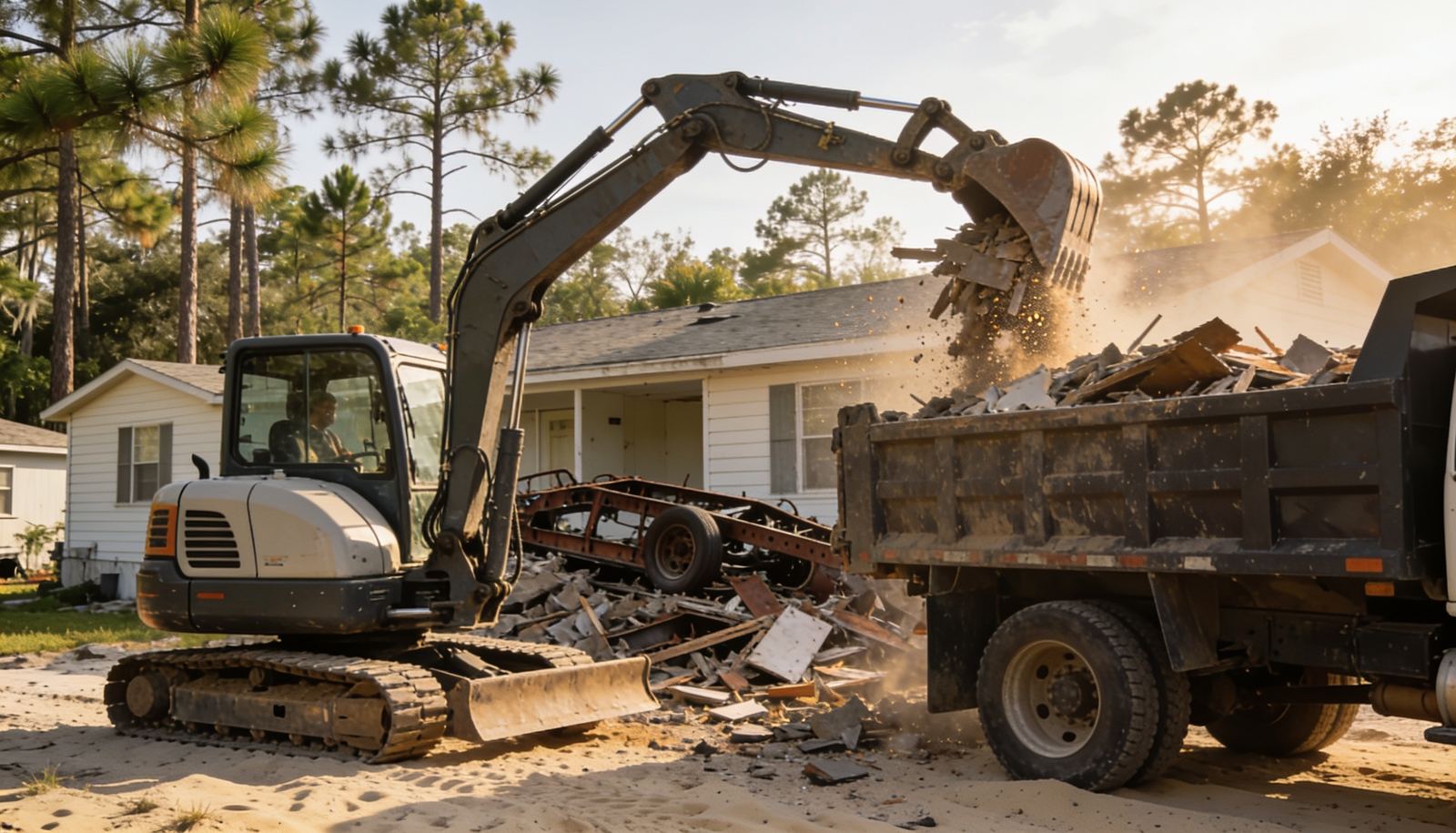
The Complete Demolition Process
1. Assessment and written quote
We look up the parcel in Marion County records, confirm the structure type and size, and check truck and excavator access. Older units on tight Silver Springs Shores lots sometimes need smaller equipment; rural Fort McCoy properties often have gate or tree-line constraints. You get one written price covering the whole job.
2. Utility disconnects
Power, water, and (if present) gas must be disconnected before teardown. If the home is on a well and septic — most of Marion County outside the city — the well gets capped and protected and the septic tank located and flagged. Septic systems that will be abandoned rather than reused have their own county process; we walk you through it. Details on the permits & process page.
3. Demolition permit
Marion County requires a demolition permit for removing a mobile home, pulled through the county's Building Safety department. We handle the paperwork as part of the job. If the home still has an active title, Florida also expects the title to be retired with the DHSMV once the unit is destroyed — a step most owners have never heard of, and one we'll flag so it doesn't bite you at closing time later.
4. Teardown
An excavator takes the structure down section by section — roof, walls, floor system — onto the pad. Singlewides typically come down in a morning. Doublewides are two structural halves and take longer, especially where the marriage line was tied into additions, porches, or a site-built roof-over (very common on 1970s–80s units in this county).
5. Chassis, axles, and tie-downs
Under every mobile home is a steel I-beam chassis, and around it are the anchors and tie-down straps that hold the unit to the ground. All of it comes out — chassis steel goes to scrap (which helps offset your disposal cost), anchors get pulled or cut below grade. A "removal" that leaves the chassis and anchor points behind isn't a removal; it's a problem for whoever builds there next.
6. Debris hauling and disposal
Demolition debris is construction & demolition (C&D) waste and gets hauled to the Marion County Baseline Landfill facility or a licensed C&D facility — weighed in, tipping fees paid, disposal documented. A typical singlewide produces roughly 15–25 tons of debris; doublewides more. Beware any bid that's dramatically cheap: disposal fees are the biggest hard cost in this job, and the only way to skip them is to dump illegally — on your name's paper trail.
7. Site cleanup
The pad gets raked and magnet-swept for nails and metal, concrete piers and skirting hauled off, and the footprint left level. If you're planning a new home on the site, we can rough-grade the pad area at the same time — cheaper than mobilizing equipment twice.
Those seven steps take 1–3 days on site, but the project around them usually runs 2–4 weeks once the permit, the utility meter pull, and any asbestos notice are counted. Full breakdown of what sets the schedule: how long mobile home removal actually takes.
Singlewide vs. Doublewide — What Changes
| Singlewide | Doublewide | |
|---|---|---|
| Typical size | 12–16 ft × 60–76 ft | 24–32 ft × 56–76 ft |
| On-site time | 1–2 days | 2–3 days |
| Debris weight | ~15–25 tons | ~25–40 tons |
| Typical cost range | $3,000–$5,500 | $4,500–$8,000 |
Additions move both numbers: built-on Florida rooms, decks, carports, and roof-overs are effectively a second small demolition. Tell us about them up front and the quote covers them — find them on demo day and they're the classic source of "surprise" charges from other outfits.
A Note on Older Units and Asbestos
Some mobile homes built before the early 1980s used materials that can contain asbestos — certain floor tiles, ceiling texture, and pipe wrap. Florida requires an asbestos survey before demolition of most structures, and reputable crews don't skip it. It's usually a quick, inexpensive check, and the overwhelming majority of units clear without issue — but it protects you legally and everyone on site physically, so it's part of a properly-run job, not an upsell. Full breakdown of the survey, costs if abatement is needed, and the 10-day notice rule: can a mobile home with asbestos be removed?